Large Language Models
Follow text through tokens, context, attention, and the steps used to generate a reply.
Start with small pieces of text
A large language model, or LLM, is a language model with many learned parameters. Modern text-generating LLMs often use a neural-network design called a Transformer.
A token is a unit of text processed by the model. It might be a whole word, part of a word, punctuation, or another small unit. Different tokenizers can divide the same sentence differently. “One token equals one word” is not a safe rule.
The tokenizer converts text into token identifiers. These are numbers referring to entries in its vocabulary. Google’s language-model introduction explains tokens and context.
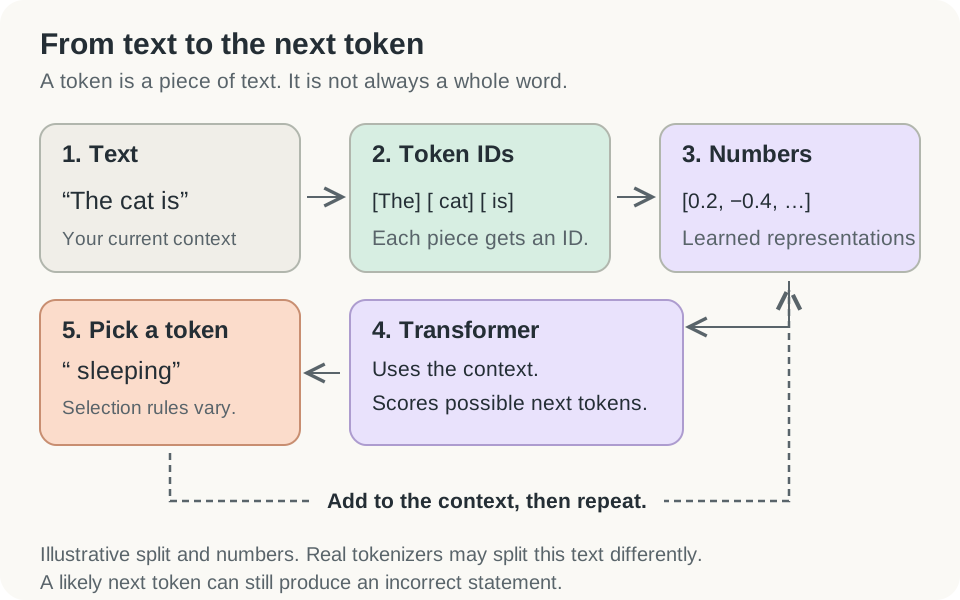
Open the diagram for a larger view.
Generation repeats this process. Each newly selected token becomes part of the context for the next step.
Numbers can represent relationships
An embedding represents an item using a list of numbers. The learned representation can capture useful relationships between items. Think of locations on a map: distance can reveal a relationship, even though the coordinates do not spell out its meaning.
Embeddings are not literal maps of understanding. Their relationships depend on training. Google’s embedding guide explains several ways to obtain them.
Attention uses context
Attention is a calculation that helps a model combine information from different positions in a sequence. In “The administrator reset the account because it was locked,” surrounding text helps determine what “it” refers to.
Attention does not guarantee correct interpretation. It is one of several calculations inside Transformers. The original Attention Is All You Need paper introduced this architecture. It is an optional advanced reference.
How a reply grows
In a common autoregressive model, generation predicts the next token from the available context, then repeats. “Autoregressive” here means that later output depends on earlier output.
Imagine the incomplete sentence, “Protect your account with a strong …” The model assigns scores to possible continuations. A generation procedure chooses a token, adds it, and continues. The chosen continuation need not always be the single highest-scoring option.
The context window is the amount of information the model can consider at once. It may contain application instructions, messages, and retrieved material. This is different from the learned parameters. Adding text to a conversation usually changes the available context, not the model’s permanent training.
Training a model and adapting it
During pre-training, a model learns broad patterns from large datasets. Many language models use self-supervised prediction targets taken from the text itself.
Fine-tuning is further training that adjusts model parameters. Prompting supplies instructions or examples at use time. These are different ways to influence behaviour. Google’s fine-tuning and prompting lesson compares them.
Some assistant models receive additional training from preferred responses. RLHF, reinforcement learning from human feedback, is one approach. It is not a compulsory step for every LLM. Other methods exist, including Direct Preference Optimization, which learns from response preferences using a different training objective.
Why powerful hardware helps
A GPU, or graphics processing unit, can perform many similar calculations at the same time. This is parallel processing. Neural-network training involves huge amounts of repeated arithmetic. GPUs make much of that work faster, helping teams train larger models on more examples. NVIDIA’s performance guide explains the connection.
This does not mean an autoregressive reply generates every token at once. Later tokens still depend on earlier output, even when calculations within a step run in parallel.
Generative AI goes beyond text
Generative AI creates content, including images, audio, and video. Multimodal means working with more than one kind of information, such as text and pictures. Google’s model catalogue shows examples across these formats.
A language model and an AI product are different things. One product may connect several specialist models or use a multimodal model. A familiar chat box does not tell you which model creates each output.
Use the output as something to check
If a model invents a believable command-line option, the sentence can read perfectly while the command fails. For a security task, compare commands with official documentation and test them in an appropriate environment. For an incident summary, compare claims with the evidence.
Check your understanding
You paste a glossary into a chat, and the next answer uses its definitions. Has the model necessarily been fine-tuned?
No. The glossary can influence the answer through the current context. Fine-tuning would involve an additional training process that changes model parameters.