The Inheritance Problem
Understand what a fine-tuned model inherits, why safety can change, and how model history helps explain risk.
A team can adapt an existing model without building a new one from the beginning. This saves work. It also means the team starts with abilities, habits, and uncertainties created by someone else.
That is the inheritance problem: the starting model still matters after you adapt it. A new name and a small training dataset do not give it a completely new history.
Start with a model that already learned
A pretrained model has already learned from data. Its weights are the numbers adjusted during training. Together, these numbers influence how it handles new inputs.
Fine-tuning means continuing training for a particular purpose. For example, a general language model might receive carefully prepared examples of short customer-support replies. Training begins with its existing weights rather than random starting values. Hugging Face fine-tuning guide.
Think of a musician who learns a new style. Their earlier practice helps them learn faster. Earlier habits may also remain. This is an analogy: a model does not learn or remember exactly like a person.
What actually changes during fine-tuning?
There are different ways to adapt a model:
| Method | What changes? | Simple meaning |
|---|---|---|
| Full fine-tuning | All the model’s trainable weights can be updated | Continue changing the main model |
| LoRA | Small added groups of parameters are trained while the original weights stay fixed | Learn a smaller adjustment to use with the base model |
LoRA means Low-Rank Adaptation. Its added parameters are often called an adapter. During use, the base model and the learned adjustment work together. The adjustment can also be merged into model weights. Hugging Face LoRA documentation.
So “fine-tuning never changes the original weights” is not a general rule. It describes some approaches, not all of them. Either approach changes the model’s effective behavior. Neither automatically removes unwanted behavior learned earlier.
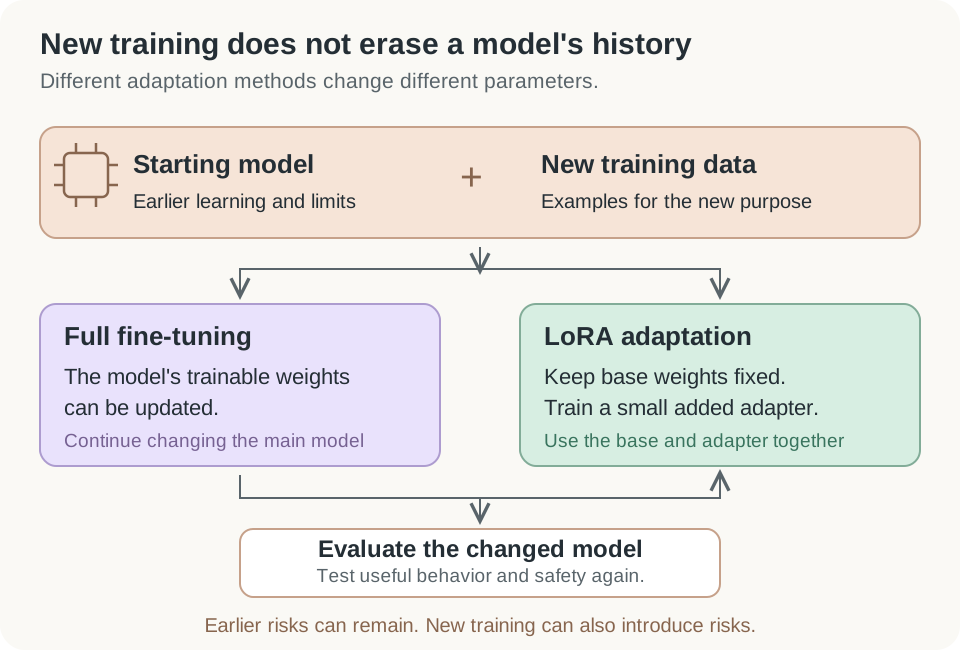
Open the diagram for a larger view.
Useful abilities and unwanted patterns can travel together
An adapted model may keep useful language skills. It may also keep unreliable associations, uneven performance between groups, or a tendency to produce confident mistakes.
Bias means a systematic pattern that can skew results. For example, a model might handle one language variety better than another because of differences in the data it learned from. Bias needs evaluation in the intended setting; it is not something that a new product name fixes. Early large language model research documented concerns about bias and other limits alongside model capabilities. GPT-3 research paper.
Fine-tuning can improve some problems. It can also leave them unchanged or introduce new ones. “Inherited” does not mean every old behavior must survive forever. It means the team should investigate what survived instead of assuming that the model was cleaned.
Better task scores do not prove safety
Safety alignment is training intended to make model behavior follow certain safety expectations. Safety regression means a later change makes some of that behavior worse.
A 2023 research study found that fine-tuning could weaken safety behavior in the models and settings tested. Some experiments used malicious training examples. Others used ordinary datasets and still observed degradation. This is evidence that safety needs to be tested again after adaptation. It is not proof that every fine-tuning job will fail. Qi and colleagues’ fine-tuning study.
Cisco also compared a Llama-2 model with several domain-adapted versions and reported worse responses to its jailbreak tests. A jailbreak is an attempt to make a model produce content it was trained to refuse. Those results describe that experiment, not a universal failure rate for modern models. Cisco’s 2024 research.
A fictional example: the repair-shop assistant
Imagine a repair shop adapting a model to draft helpful replies. This is an original teaching example, not a report of a real test.
The team trains it on approved examples about opening hours and repair bookings. Replies become shorter and clearer. That is useful evidence about writing style.
Now imagine someone asks it to promise a free repair. A fluent answer could still be wrong. Better writing does not give the model authority to approve an offer.
The team therefore needs separate questions:
- Does it explain shop policy correctly?
- Does it invent promises when the answer is missing?
- Does it handle different wording and language levels fairly?
- Can it access or change anything beyond its assigned job?
The application should enforce permissions. A model’s reply cannot create permission that the user does not have.
Keep the model’s family history
Lineage means the record of where a model came from and how it changed. A checkpoint is a saved state of model parameters at a particular point.
For the fictional assistant, useful records would include:
| Component | Record to keep |
|---|---|
| Base model | Publisher, exact revision, source, and file identifiers |
| Adapter, if used | Its version and the base revision it expects |
| Tokenizer | The version that converts text into model tokens |
| Training data | Dataset version and preparation history |
| Final model | Any merging, pruning, or quantisation steps |
| Evaluation | Which complete version was tested, when, and with what results |
NCSC recommends tracking AI assets and documenting security-relevant development information. This includes model and data history, limitations, and file hashes or signatures. NCSC secure development guidance.
If a supplier later identifies a problem in one revision, lineage helps the shop find affected systems. A familiar model name alone may not identify the files actually running.
Check your understanding
Does fine-tuning always leave the base model's weights unchanged?
No. Full fine-tuning updates the model’s trainable weights. LoRA usually keeps the base weights fixed and learns added parameters. Both can change the final behavior.
The repair assistant writes better replies. Has it passed a safety test?
Not necessarily. Writing quality is one result. The team still needs evidence about incorrect promises, private information, permissions, and other relevant risks.
Why keep the base revision and adapter version together?
They work together to produce the final behavior. Recording the pair helps explain results, reproduce a release, and identify which systems may be affected by a reported problem.