Introduction
Follow the journey from collected data to a deployed model, and see why security starts before the first answer.
An AI assistant may look like a simple chat box. Behind that box are many earlier choices: which examples to collect, which model to start with, what to change during training, and which tests to trust. Those choices affect the answers people receive.
This room is about understanding that history. A useful first question is “What went into this model, and what evidence do we have about it?” A model’s name or a convincing demonstration cannot answer that on its own.
These notes accompany AI Models & Data on TryHackMe. My study record includes my shared room achievement.
See the whole journey
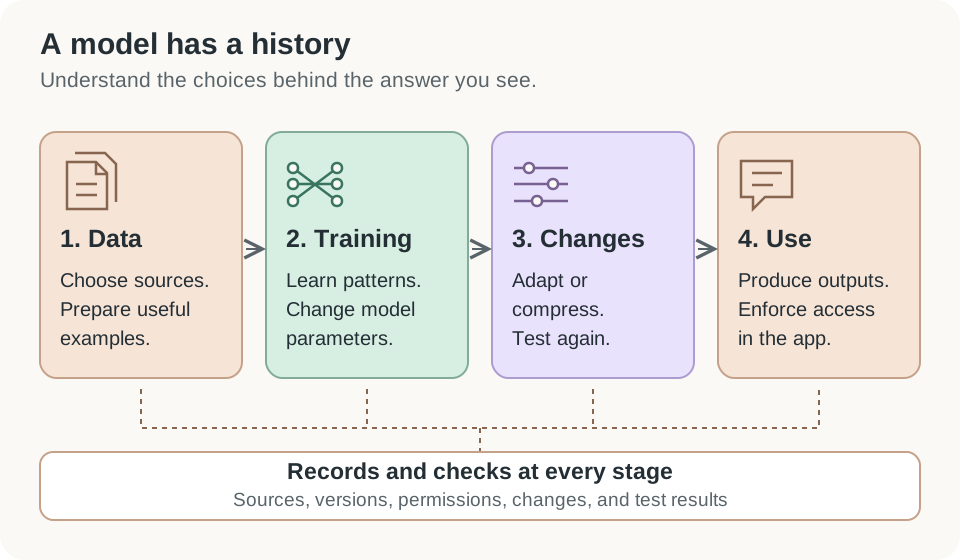
Original illustration. Open it for a larger view. The arrows show a simplified journey; real projects may repeat stages.
Data is the information used by the system. It could be text, pictures, sound, or numbers. A dataset is a collection of examples arranged for a purpose.
Training changes a model’s internal numbers using examples. Those numbers are its parameters. Inference means using a trained model to produce an output. Training and inference are different stages.
The word model also differs from application. A model may predict text. The application around it decides who can sign in, which documents it can access, and which tools it can use. Good model behavior does not replace those application checks.
An everyday example
Imagine a local library wants an assistant to answer questions about opening hours and events. This is an example for learning.
The library already has useful public event pages. It also has private borrowing records. Both contain information, but only one is needed for an events assistant. Copying every available record into training would create an unnecessary privacy problem.
Suppose the team starts with a model from another organization. That model already has learned abilities and limitations. The library adds examples of its preferred writing style. Later, it compresses the model to fit a smaller computer.
There are now several questions to answer. Which public pages were used? Were old event notices removed? Which original model version was chosen? Did compression change the answers? Which records support those claims?
The questions become easier when the team keeps records as it works. Reconstructing the history after a problem can be much harder.
Four things worth protecting
| What matters | Plain meaning | Library example |
|---|---|---|
| Privacy | Personal information reaches only the people allowed to receive it | Borrowing records stay out of public answers |
| Integrity | Important information and files are not changed without permission | An outsider cannot replace the approved event guide |
| Reliability | The system works well enough for its intended job | It gives the correct opening hours across common question styles |
| Accountability | Someone is responsible, and decisions can be checked | A named owner keeps model versions and test results |
These properties overlap, but they are not identical. An answer can be factually correct and still reveal private information. A model can be fast and still fail a necessary task.
NIST’s voluntary AI Risk Management Framework treats risk management as part of design, development, use, and evaluation. This supports a useful habit: decide what evidence you need throughout the system’s life, rather than relying on a final demonstration. NIST AI Risk Management Framework.
What each note explains
Start with Training Data to understand sources, sensitive information, and records of where data came from. Continue with Building the Model for training, compression, and learning across separate organizations.
The Inheritance Problem explains what changes when you adapt someone else’s model. The Black Box Problem explains what documentation and tests can tell you, and where they have limits. The Conclusion connects the ideas in a short revision guide.
The published notes keep the room’s original task numbers. Task 6 Practical is omitted from this notebook.
A model file also needs safe handling
There are two different concerns when accepting a model: the behavior it has learned, and the software involved in loading it. Some file formats can execute code when loaded. A plausible model description does not make that safe. Use trusted sources and approved loading tools, and review any code the model requires. Hugging Face documents this distinction in its guidance on pickle-file risks and scanning.
This is another reason to keep the model’s source, version, files, and dependencies together. Dependencies are other software pieces the system needs to run.
Check your understanding
A model gives one correct answer. Does that tell us where its training data came from?
No. The answer shows behavior on that one input. Source records are needed to explain the data's history. Behavior tests and source records provide different evidence.
Why should the library separate public event pages from private borrowing records?
The assistant does not need borrowing records to explain events. Keeping unnecessary private data out reduces the information that could be exposed.
Does adapting a model remove the need to understand the original model?
No. The adapted model still depends on earlier work. Its original source, known limits, and behavior remain relevant.