Conclusion
Connect data history, training choices, inherited behavior, and model documentation in one clear revision guide.
A useful AI model is more than a file that produces answers. It has a history. Data was collected, a training process changed numbers, people made design choices, and later changes may have altered its behavior.
The central lesson is to connect each important claim to evidence. “The data was checked” should lead to a record of the checks. “This model performs well” should lead to results for a particular version and a relevant test. “It fits on our computer” should not be mistaken for “it is safe for our work.”
Put the room together
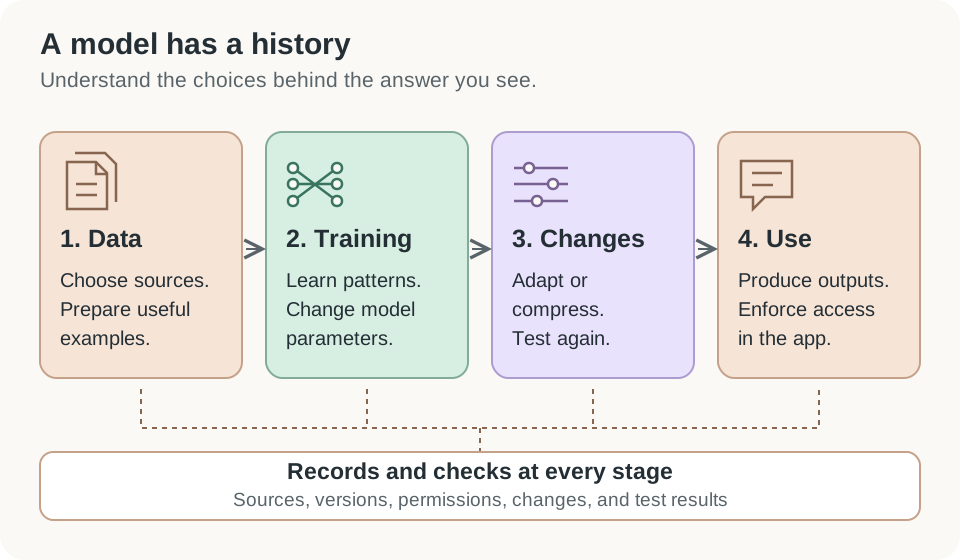
Open the original illustration for a larger view.
| Topic | Main idea | Read the detailed note |
|---|---|---|
| Training data | Find out where examples came from and whether they contain information the model should not use | Task 2 |
| Building the model | More training, smaller files, and distributed learning each involve different trade-offs | Task 3 |
| Inheritance | Adapting an existing model changes it without erasing the importance of its earlier history | Task 4 |
| The black box problem | Documentation and testing reduce uncertainty, but neither proves every possible behavior | Task 5 |
Connect a claim to the right evidence
Consider a fictional team choosing a model for a public event assistant. The team receives three statements from a supplier.
“We used clean data.” The word “clean” is incomplete. It might mean that empty records were removed, duplicate pages were filtered, or sensitive fields were reviewed. Ask which checks were performed, on which data version, and what they found. These checks answer different questions.
“The model scored well.” A result needs context. Was the test about public event questions or an unrelated task? Were the examples kept separate from training? Which language and model version were tested? A useful result should describe both successes and errors.
“The smaller version is equivalent.” Compression changes how information is represented. The team needs results for the actual smaller version it will deploy. Tests of a different version may be helpful background, but they do not settle the question.
This example shows how to replace a broad reassurance with a question that can be answered. It is a way of reading evidence, not a claim that an audit was performed.
Keep these distinctions clear
- Publicly visible is not the same as suitable for training. Consider the source, permissions, sensitive content, and intended use.
- A model is not a database. It does not keep every record as a searchable row. Some training content can nevertheless be memorized or exposed.
- Overfitting is not a privacy verdict. Poor performance on new examples and disclosure of particular training records need different evidence.
- Fine-tuning changes model behavior. Full fine-tuning changes model weights; adapter methods can hold the original weights fixed while learning added parameters.
- Local training is not automatic privacy. Shared updates can still carry information about local data.
- A model card is documentation. Its claims need supporting records and tests.
The linked task notes explain each distinction with primary sources and examples. For a broader approach to assigning responsibilities and reviewing risks, see NIST’s AI Risk Management Framework.
A short glossary for revision
| Term | Simple meaning |
|---|---|
| Provenance | The history of where something came from and what happened to it |
| Epoch | One pass through the training dataset |
| Validation | Checking examples kept aside to guide model choices |
| Quantisation | Representing numbers using a smaller set of possible values |
| Pruning | Removing selected parts or connections of a model |
| Federated learning | Training across separate participants that share updates instead of pooling their raw training data |
| Fine-tuning | Further training that adapts an existing model |
| Model card | A document describing a model’s purpose, evaluation, and limitations |
Explain the lesson in your own words
Try a short explanation like this:
“An AI model learns from examples, so the examples matter. Changing or compressing a model can change its behavior. When we use someone else’s model, we need to understand its history as well as our own changes. We need records and relevant tests before deciding whether it is suitable.”
You do not need to remember every research paper. Being able to ask a clear question, understand the answer, and identify what is still uncertain is more useful than repeating technical terms.
Check your understanding
A supplier gives you a detailed model card. What else would help you assess its claims?
Look for the exact model version, relevant evaluation results, information about the data and its processing, and records of later changes. A card summarizes evidence; it does not replace all of it.
A compressed model is smaller and faster. What does that tell you about its safety?
It tells you about size and speed under the conditions tested. It does not establish privacy, resistance to misuse, or correct answers. Those properties need their own checks.
What should happen if a team cannot answer an important question about a model?
Record the uncertainty and decide how it affects the intended use. The team may need more evidence, a narrower use, a stronger control, or a different model. An unknown should not silently become an assumption that everything is safe.
My study record
I reported finishing AI Models & Data and shared my TryHackMe room achievement. These notes were documented on 8 October 2026. They cover tasks 1–5 and 7; Task 6 Practical is intentionally not included.