Conclusion
Connect AI weaknesses, AI-assisted attacks, defensive uses, and secure design with a plain-English recap and revision questions.
AI security asks two connected questions: how could someone misuse AI, and how could someone damage the system that uses it? Defenders can also use AI to help investigate problems. All three areas need careful checks.
These notes cover all seven tasks in the AI Security Threats room. This recap brings the ideas together. Use the linked task notes for examples, diagrams, and primary references.
Four ideas to remember
| Idea | In simple English | Open the explanation |
|---|---|---|
| AI has weaknesses | Bad inputs, exposed data, stolen models, or changing conditions can cause trouble. | Vulnerabilities in AI Models |
| Attackers can use AI | It can help create convincing messages, synthetic voices, and code. | AI-Enhanced Attacks |
| Defenders can use AI | It can help sort information and draft an investigation. People still need evidence. | Defensive AI |
| Protection needs several controls | Limit access, check data and tools, test behavior, and keep watching after release. | Securing AI |
Follow one ordinary request
A customer asks a shopping assistant: “Where is my order?”
The application first identifies the customer. It checks which order that customer may read. It finds the relevant record and supplies it to the model. The model writes a friendly explanation. The application then shows the answer.
Now ask what could go wrong at each step:
- A stolen login could let someone pretend to be the customer.
- A missing permission check could expose another customer’s order.
- A corrupted reference document could add misleading instructions.
- The model could invent a delivery date that the record does not contain.
- An unnecessary tool could let a mistaken answer trigger a real action.
This is an original example. It shows why checking only the wording of a prompt leaves important parts of the system unchecked.
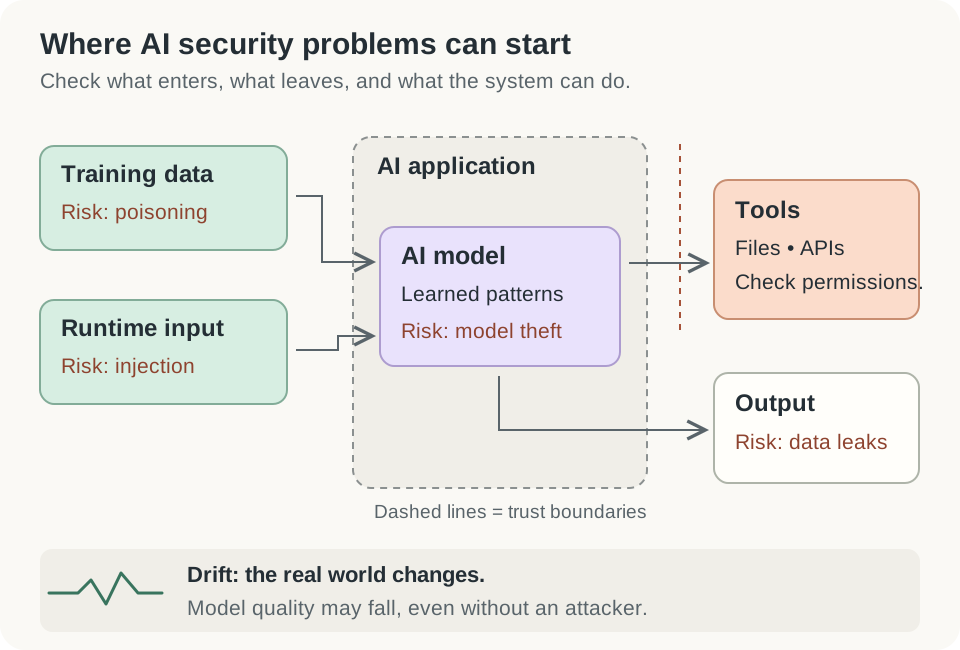
Open the diagram for a larger view. Follow the information from its source to its possible effects.
Words that are easy to confuse
| Word | Meaning | Useful distinction |
|---|---|---|
| Vulnerability | A weakness that could be used to cause harm. | Finding a weakness does not prove someone used it. |
| Threat | Something that could cause harm. | An attacker is one possible source of a threat. |
| Risk | The possibility and consequences of harm in a particular situation. | The same weakness may matter more in a payment tool than in a toy demonstration. |
| Control | A measure used to reduce risk. | A control helps only if it is present, works, and covers the relevant path. |
| Hallucination | A generated claim that is unsupported or wrong. | It does not, by itself, prove an attack. |
| Drift | A change in data or conditions around a model. | It can happen during ordinary business changes. |
For a shared vocabulary of attacker behavior, explore MITRE ATLAS. It collects AI-related techniques and case studies from observed attacks and realistic demonstrations. Read the evidence behind a case before assuming it describes every AI product.
Five quick revision questions
1. A chatbot reveals an order belonging to someone else. Which check belongs outside the model?
An authorization check: the application must decide whether this signed-in user may access that order. A prompt asking the model to keep orders private cannot replace it.
2. A convincing message asks you to skip a normal approval. What matters more than perfect grammar?
Whether the request is genuine and allowed. Verify it through an established channel and follow the normal process. Smooth writing cannot prove identity or trustworthiness.
3. An AI report says a machine was compromised. What should an analyst ask for?
The supporting records and a clear explanation of what each record shows. Check the machine, time range, and event details. Separate direct observations from the model’s guesses.
4. Why might a read-only assistant be safer than one that can change accounts?
It has fewer ways to cause harm if it makes a wrong decision. Read-only access still needs restrictions because reading private information can itself cause harm.
5. A model passes a test today. Can the team stop monitoring it?
No. Users, documents, integrations, models, and attack methods can change. Keep reviewing useful outcome measures and investigate unexpected behavior.
Explain it without technical words
Try explaining the room to a friend in four sentences. You might say:
“AI can be helpful, but it can make mistakes. People can use it to deceive others, or feed an AI system bad information. We protect the system by checking who can use it, what it can read, and what it can do. We check its answers and actions against real evidence.”
Then return to the ten Practical questions. Try answering each one before reading its explanation. Explain the idea in your own words, and review any answer you find difficult. Pay attention to the notes about the wording of questions 6 and 7.